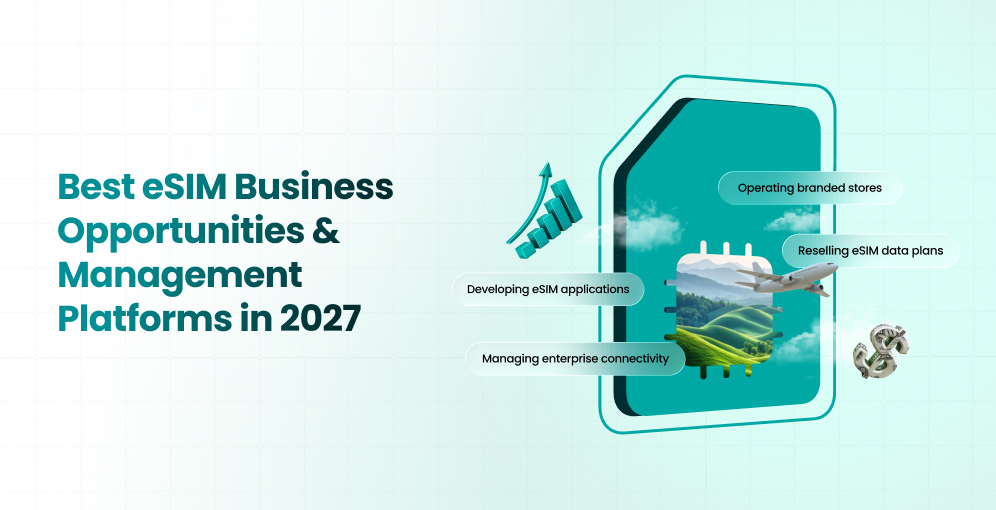
Why is every fintech magazine obsessed with the eSIM business for entrepreneurs? We found the answer! eSIM is the future. Using eSIM business opportunities, entrepreneurs can build businesses around mobile data reselling, white-label eSIM stores, travel connectivity, enterprise services, and custom software development.
Companies can use established connectivity suppliers or develop branded applications to manage customer accounts and digital data plans. The right approach depends on the customers you want to serve and the technology required to deliver the service.
- A reseller needs access to mobile data plans.
- A travel company may prefer an API integration.
- An enterprise managing connected devices needs specialized connectivity management tools.
Overall, businesses launching their own branded eSIM products may need both a connectivity supplier and a software development partner. In this guide, we explore the leading opportunities and management platforms worth evaluating when planning an eSIM business for 2027.
What is an eSIM business opportunity?
An eSIM business opportunity allows companies to earn revenue by selling digital mobile connectivity or providing related technology services. Any company can develop an eSIM app and launch its product in the market.
The common eSIM models are:
- Reselling eSIM data plans
- Operating branded stores
- Managing enterprise connectivity
- Developing eSIM applications
Many businesses can enter the market without owning a mobile network. An eSIM is a digital SIM technology that allows compatible devices to download and manage mobile network profiles.
- The underlying technology uses an embedded universal integrated circuit card (eUICC).
- Supported devices can receive connectivity profiles through remote SIM provisioning.
Customers can often install profiles using QR codes or supported in-app activation methods.
According to the GSMA’s eSIM technical documentation, remote SIM provisioning supports digital connectivity management across consumer and IoT devices.
For entrepreneurs: The business opportunity comes from how these services are packaged and delivered.
For travel companies: They may sell destination-specific data plans. Software companies can develop the systems that enable purchases and account management.
For resellers: A reseller does not necessarily operate mobile network infrastructure. The business can work with a connectivity supplier under an appropriate commercial agreement.
What are the best eSIM business opportunities in 2027?
Businesses entering the eSIM market can pursue several models. Each serves different customers and requires different technical capabilities.
The following opportunities are worth evaluating based on currently available services and business models.
1. eSIM reseller business
An eSIM reseller purchases access to connectivity products through an authorized supplier and sells them to end customers. The supplier handles the underlying connectivity arrangements. The reseller focuses on selling plans and supporting customers according to its agreement.
In contrast, a travel-focused reseller may offer data plans for customers visiting the United States or Europe. The business can earn revenue through the difference between its selling price and the costs associated with each order. In this process, resellers should evaluate wholesale pricing and activation support before committing.
Best suited for: Entrepreneurs and telecom retailers seeking a relatively straightforward connectivity distribution model.
2. White-label eSIM business
A white-label eSIM platform lets companies sell connectivity services under their own brand. The solution may include a customer storefront or application alongside plan management tools. Hence, a business can develop its brand identity while using connectivity supplied by an established provider.
Anyway, white-label arrangements vary. Some providers supply a hosted storefront. Others offer APIs and branding features that require additional software work. So founders should clarify responsibility for billing and customer support.
Best suited for: Startups and established brands seeking a differentiated customer-facing service.
3. Travel eSIM marketplace
Travel agencies and booking platforms can offer eSIM plans as additional products. Customers may purchase a destination-specific plan while booking accommodation or arranging a trip.
A travel marketplace can integrate packages from a connectivity supplier through an API. The application can then display available plans and process purchases.
Likewise, travel businesses already have access to relevant customers. An eSIM product can become an additional revenue stream within the existing booking journey.
Best suited for: Travel agencies, airlines, online booking platforms, and travel applications.
4. Corporate travel eSIM management
Companies with internationally mobile employees need organized connectivity purchasing and administration. A corporate eSIM management solution can help administrators assign data plans to employees.
Business platforms may also provide usage information and consolidated billing. The commercial opportunity includes managed connectivity services and business account administration.
Best suited for: Corporate travel providers and businesses serving internationally distributed teams.
5. IoT and M2M eSIM connectivity
Internet of Things (IoT) businesses use cellular connectivity for devices such as trackers and industrial equipment. Many deployments require remote provisioning and ongoing device management.
An IoT connectivity platform can help businesses monitor SIM status and manage network connections. However, the requirements differ from consumer travel eSIM services.
IoT deployments may need device lifecycle management and integration with existing operational software. The GSMA’s SGP.32 specification addresses remote SIM provisioning for IoT environments. Data source: GSMA
Best suited for: IoT service providers, device manufacturers, and enterprise technology companies.
6. Custom eSIM app and platform development
Technology companies can also develop the software used to sell and manage eSIM services. A custom eSIM platform may combine a mobile application with a web storefront and administrative dashboard.
Businesses can integrate third-party connectivity APIs and develop specialized billing workflows. The development company supplies the software while a connectivity partner supplies the data plans.
Best suited for: Connectivity startups and established businesses requiring specialized eSIM management software.
eSIM business model comparison
| Business model | Target customers | Revenue opportunity | Main requirement |
| eSIM reselling | Travelers and consumers | Retail plan markup | Wholesale connectivity partner |
| White-label eSIM | Startups and brands | Branded data plan sales | White-label solution |
| Travel marketplace | Travel platforms | Sales margins or commissions | Supplier API integration |
| Corporate eSIM | Businesses | Managed connectivity services | Business account management |
| IoT connectivity | Connected-device businesses | Connectivity subscriptions | IoT connectivity provider |
| Custom eSIM platform | Startups and service providers | Depends on the product model | Software development partner |
Note: Founders should evaluate the capabilities they can manage internally before selecting a business model.
Which platforms are best for managing eSIM business opportunities?
Different providers solve different problems. A connectivity supplier cannot always replace a custom development company. The best eSIM business management platform depends on the intended business model.
The following platforms offer capabilities worth comparing.
- Airalo Partners and eSIM Go support connectivity distribution.
- CELITECH offers travel-focused integrations. Holafly and Saily serve business travelers.
- Hologram, emnify, and Onomondo specialize in IoT connectivity.
- Kolpolok develops custom applications and management platforms.
Airalo Partners: eSIM reselling and API integration
Airalo Partners offers several ways for businesses to distribute travel eSIM products. Its partner solutions include reseller tools and connectivity integrations. Businesses can use its REST API or software development tools to integrate eSIM products into existing applications. Airalo also offers e-commerce integrations and a separate corporate connectivity solution. A travel booking company may use the API to add mobile data plans to its checkout experience.
Best suited for: Travel businesses, digital platforms, and eSIM resellers seeking established connectivity distribution tools.
eSIM Go: Wholesale connectivity and white-label solutions
eSIM Go provides wholesale eSIM services and integration tools for businesses. Its API supports connectivity product distribution and management. Businesses can use its partner platform or develop their own customer-facing systems.
The provider also offers branding options for supported eSIM experiences. Developers can reference the eSIM Go API documentation when planning integrations. The model suits businesses that want more control over storefront design while sourcing connectivity externally.
Best suited for: eSIM resellers and companies developing branded connectivity services.
CELITECH: eSIM integrations for travel platforms
CELITECH offers eSIM integration options for travel-related businesses. Its platform lets partners add mobile connectivity to existing customer journeys.
Travel companies can integrate eSIM purchasing alongside bookings or offer connectivity as an additional benefit. CELITECH documents API functionality for developers working with travel applications. The CELITECH developer documentation covers available integration methods.
Best suited for: Airlines, online travel agencies, and businesses embedding connectivity into travel services.
BNESIM: Reseller and branded connectivity solutions
BNESIM provides several business partnership options. Its current partner offering includes distributor arrangements and API integration. The company also advertises white-label eSIM solutions for businesses launching their own brands.
- A distributor can focus on selling connectivity products through an established customer network.
- An API partner may prefer to incorporate connectivity into a separate application.
Best suited for: Telecom retailers and companies seeking reseller or branded connectivity arrangements.
Holafly: Corporate travel connectivity
Holafly for Business focuses on mobile data services for organizations with traveling employees. Its Business Center supports plan administration and billing management. Companies can assign supported eSIM plans to employees and review related account information. The service is primarily a corporate connectivity solution, not a general custom software development platform.
Best suited for: Organizations managing international employee travel.
Saily: Business eSIM management
Saily for Business offers a business dashboard for managing travel connectivity. Administrators can add team members and assign suitable plans. The service also supports remote monitoring of data usage for connected business accounts. Companies can use the dashboard without developing their own eSIM application.
Best suited for: Small and medium-sized businesses requiring centrally managed employee connectivity.
GigSky: Business travel eSIM administration
GigSky for Business offers connectivity management for corporate travelers. Its business platform supports eSIM assignment and administration. Organizations can manage supported plans and monitor connectivity-related expenses. GigSky also offers different arrangements for self-service customers and larger business deployments.
Best suited for: Corporate travel teams needing centralized SIM administration.
Hologram: IoT connectivity management
Hologram provides connectivity management tools for IoT deployments. Its dashboard allows businesses to monitor connected devices and manage SIM activity. The platform also supports integrations through an API. Hologram’s eSIM profile offering targets IoT use cases rather than general consumer travel data resale.
Best suited for: IoT businesses managing connected devices and cellular deployments.
emnify: Enterprise IoT connectivity
emnify focuses on cellular connectivity for IoT applications. Its management portal allows organizations to review device activity and connectivity status. The platform also supports eSIM profile management for compatible deployments. Advanced functionality includes remote profile operations for supported IoT devices.
Best suited for: Enterprise IoT projects requiring connectivity visibility and lifecycle management.
Onomondo: IoT connectivity and remote management
Onomondo provides an IoT connectivity management platform. Businesses can administer SIMs and monitor device activity through its management interface. The platform supports APIs and webhooks for integration with operational systems. Onomondo also provides remote eSIM profile management through its IoT-focused offerings.
Best suited for: Businesses managing distributed IoT devices and complex connectivity requirements.
Kolpolok Limited: Custom eSIM app and management platform development
Kolpolok Limited develops software for businesses launching branded eSIM services. Our development scope can include Android and iOS applications, along with web-based administrative tools.
We integrate supported third-party eSIM APIs and develop customer management workflows. Businesses can also request subscription management and payment integrations based on their requirements.
Kolpolok Limited operates as a software development partner. Connectivity supply and carrier services remain the responsibility of the selected provider unless separately agreed.
Best suited for: Startups and enterprises developing custom eSIM applications or management platforms.
Comparison of eSIM business platforms
| Platform | Primary category | Suitable business use |
| Airalo Partners | Reseller and API platform | Travel eSIM distribution |
| eSIM Go | Wholesale and white-label connectivity | Branded eSIM stores |
| CELITECH | Travel connectivity integration | Booking platforms |
| BNESIM | Distribution and white-label services | Reseller businesses |
| Holafly | Corporate travel connectivity | Employee data management |
| Saily | Business travel eSIM platform | Team connectivity |
| GigSky | Corporate connectivity services | Business SIM administration |
| Hologram | IoT connectivity platform | Connected-device management |
| emnify | Enterprise IoT connectivity | IoT provisioning and monitoring |
| Onomondo | IoT management platform | Device and SIM administration |
| Kolpolok Limited | Custom software development | Branded eSIM apps and dashboards |
The comparison reflects each company’s publicly documented service focus rather than an overall ranking.
What is the difference between an eSIM connectivity provider and an eSIM development company?
An eSIM connectivity provider supplies access to mobile network services and eSIM profiles. An eSIM development company creates the applications and management software used to sell or administer those services.
Many branded eSIM businesses need both types of partners.
Role of a connectivity provider
- Connectivity providers supply or arrange access to mobile data plans.
- They may also manage eSIM provisioning and offer reseller APIs.
- The commercial agreement determines available plans and responsibilities for connectivity support.
Role of a development company
- Development companies build the software that connects customers to the service.
- Their work may include application design and API integration.
- They can also develop billing systems and administrative dashboards.
Can businesses use both?
Yes. A business can purchase connectivity services from one supplier and commission its customer-facing software from another company.
| Responsibility | Connectivity provider | Development company |
| Mobile data plans | Supplies or sources | Integrates with supplier |
| Network access | Provides or arranges | Not the primary service |
| eSIM provisioning | Provides supporting service | Integrates workflows |
| Branded application | Depends on offering | Develops |
| Custom dashboard | Depends on offering | Develops |
| Payment integration | May offer | Develops as required |
| Business customization | Provider-dependent | Based on project scope |
Businesses should define each supplier’s responsibilities before starting development.
How to start an eSIM business in 2027
Entrepreneurs can launch an eSIM business by selecting a market and securing a suitable connectivity supplier. Next, choose software and integrate purchasing workflows. Businesses should then test activation and payment processes before accepting customers.
Step 1: Choose your business model
First, the development model should reflect available resources and customer requirements. Decide how the company will generate revenue.
- A reseller model may suit a business focused on selling data plans.
- A custom platform may suit a company introducing specialized services.
Step 2: Identify your target customers
Next, research the audience you want to serve.
- Travelers may value destination-specific data plans and straightforward activation.
- Corporate customers may need centralized billing and account administration.
- IoT businesses have different requirements involving device provisioning and long-term connectivity management.
Step 3: Select an eSIM connectivity partner
Compare suppliers by supported destinations and available products. Review wholesale pricing and API documentation. Also confirm activation support and refund arrangements. Document the provider’s technical support responsibilities before launch.
Step 4: Choose your eSIM business platform
Businesses can use a ready-made reseller portal or white-label storefront. Companies that need more customization may prefer a dedicated application. The platform should support the intended sales process and customer experience.
Step 5: Integrate eSIM APIs and payments
Developers can connect the platform with the selected supplier’s API. The integration may support plan listings and purchases. It can also deliver activation information and retrieve order status. Payment processing should be connected to the correct order records. Teams should prevent duplicate orders during network retries and handle failed transactions correctly.
Step 6: Develop the customer app and admin dashboard
A branded application can allow customers to browse plans and review purchases.
The administrative dashboard can help staff manage accounts and orders. Developers should define account permissions and operational reporting requirements.
Step 7: Test and launch
Before publication, test the customer journey across supported devices.
- Check plan purchasing and activation information.
- Review payment errors and customer support procedures.
US businesses should also assess applicable registration and tax requirements. Consumer protection obligations and telecom-related rules may require advice from qualified professionals.
What features should an eSIM business management platform have?
A reliable eSIM business management platform should support customer accounts and plan purchases. It also needs supplier integration and clear administrative controls.
The required features depend on the business model.
eSIM provisioning and activation management
- The platform should coordinate eSIM orders with the connectivity supplier.
- Supported workflows may include QR-code delivery and activation status information.
- The actual installation process depends on the device and supplier integration.
- A customer-facing application should clearly explain supported activation methods.
Customer and account management
- Businesses need systems for customer registration and account administration.
- Customers should be able to review previous orders and available plan information.
- Administrators may require separate permissions for support and financial operations.
Data plan and subscription management
- The system should display available plans and their relevant conditions.
- Customers may need to check validity periods and remaining allowances.
- Renewal and top-up functionality depends on the supplier’s products and supported APIs.
Payment and billing integration
- A commercial eSIM platform should record transactions accurately.
- The billing workflow may include payment gateways and receipts.
- Businesses should also prepare processes for failed orders and refunds.
API and third-party integrations
- Supplier APIs connect the application with the underlying connectivity service.
- Payment systems and customer relationship management tools may require separate integrations.
- Developers should account for API authentication and changing supplier responses.
- Secure credential handling and error monitoring are essential.
Centralized administrative dashboard
- An administrative dashboard provides operational visibility.
- Staff can review customer orders and supported plan information.
- Depending on project scope, administrators may also manage account permissions and subscription status.
Business analytics and reporting
- Business owners need reliable sales and operating information.
- Useful reporting may include order volume and payment performance.
- Businesses can also monitor activation failures and customer support demand.
(The selected supplier determines which connectivity usage information the API can retrieve.)
What are the benefits and challenges of starting an eSIM business?
An eSIM business can distribute digital connectivity without maintaining physical SIM card inventory for every customer. Still, the business needs dependable suppliers and suitable operating systems. Companies serving different markets need to consider applicable consumer and telecommunications regulations.
Potential benefits
- Digital delivery lets customers buy compatible connectivity products without visiting a physical retail location.
- Travel companies can introduce eSIM products into their existing services.
- Startups can build branded customer experiences using third-party connectivity.
- Some business models also support repeated customer purchases or subscription revenue.
Common challenges
- Finding an appropriate supplier can require detailed commercial evaluation.
- Wholesale costs and customer acquisition expenses influence profit margins.
- Activation problems may also create customer support demand.
- Technical teams must maintain integrations as APIs and operating-system requirements change.
How much does it cost to start an eSIM business?
The cost of starting an eSIM business depends on the software approach and connectivity agreement. Reseller platforms may involve setup fees and recurring service charges. Custom applications require development investment and ongoing maintenance. Marketing and support expenses also affect the overall budget.
Main cost categories
| Cost category | What businesses should budget for |
| Connectivity supply | Wholesale plans and supplier commitments |
| Platform setup | Reseller or white-label software fees |
| Custom development | Mobile apps and management systems |
| API integration | Supplier and payment connections |
| Hosting | Backend infrastructure and operational services |
| Marketing | Customer acquisition and campaigns |
| Support | Activation and billing assistance |
| Compliance | Legal advice and applicable requirements |
| Maintenance | Security updates and software improvements |
Reseller platform vs custom development costs
- A ready-made reseller portal may reduce initial software requirements. The provider may charge recurring fees or apply a commercial margin to plan sales.
- Custom development generally involves more initial engineering work. In return, businesses can define their own application design and operational workflows.
Both options require ongoing financial management.
How can businesses estimate profitability?
Founders should estimate how much contribution remains after each sale.
Consider a hypothetical eSIM plan sold for $12.
| Financial item | Illustrative amount |
| Retail selling price | $12.00 |
| Wholesale connectivity cost | $8.00 |
| Payment and variable support costs | $1.20 |
| Contribution per sale | $2.80 |
Contribution per sale = Retail revenue − Wholesale cost − Other variable costs
The hypothetical contribution is $2.80 before fixed expenses and applicable taxes. Customer acquisition costs and software expenses must still be recovered. Actual results depend on supplier contracts and customer behavior.
Note: To learn about eSIM application development costs, you can read our guide on eSIM app development costs.
How can Kolpolok Limited help businesses launch an eSIM platform?
Kolpolok Limited helps businesses develop branded eSIM applications and supporting management software. Our development services focus on the technology needed to operate a digital connectivity business. Companies can work with us to develop applications around their selected connectivity supplier and customer requirements.
Custom eSIM application development
We develop mobile eSIM applications for Android and iOS based on project scope. The customer experience can include plan browsing and purchase management.
Our teams also work on backend integrations required to connect the application with supported third-party services.
API and subscription integration
Businesses may require data plan APIs and payment systems. Kolpolok Limited can develop integrations around the selected suppliers’ supported capabilities. Additional software work may include subscription administration and customer account management.
Administrative platform development
We also develop centralized management systems based on business requirements. The scope can include user administration and order management. We can plan reporting features and custom workflows during requirements analysis.
Software development vs connectivity supply
Kolpolok Limited focuses on eSIM software development and integration. Businesses remain responsible for arranging connectivity supply through their chosen provider unless the agreed project scope specifies other responsibilities. Our development work can connect the branded application with that provider’s supported services. Explore custom eSIM app development to learn about our services.
Final thoughts
In conclusion, entrepreneurs exploring eSIM business opportunities in 2027 can choose from reselling and white-label services to corporate connectivity and software development. The right platform depends on the business model and operational requirements. Development companies (like ours) help businesses create the applications and management systems around those services.
Frequently asked questions about eSIM business opportunities
What is an eSIM business opportunity?
An eSIM business opportunity involves selling digital connectivity products or building technology that supports eSIM services. Businesses can generate revenue through reselling and branded stores. Corporate connectivity and custom platform development are other possible models.
Which platforms are best for managing eSIM business opportunities?
Airalo Partners and eSIM Go are relevant for connectivity distribution. Hologram and emnify focus on IoT management. Holafly and Saily offer corporate travel solutions. Companies needing specialized branded applications can work with development partners such as Kolpolok Limited.
Can I start an eSIM business without owning a mobile network?
Yes. Businesses can enter the market through reseller and white-label agreements. A connectivity provider can supply the underlying mobile data service. The business manages its customer offering according to the agreement and applicable regulations.
What is the difference between an eSIM reseller and a white-label eSIM business?
An eSIM reseller sells products supplied by a connectivity provider. On the other hand, a white-label business uses its own branding and customer-facing experience. Both models may depend on third-party network infrastructure and data plan suppliers.
How can I launch my own branded eSIM app?
Start by selecting a connectivity supplier and defining your target customers. Develop or customize the application and integrate the supplier’s API. Add payment and account management features as needed. Test the full purchase and activation process before launch.
Do I need an eSIM API to start an eSIM business?
Not every eSIM business needs direct API access. A reseller portal may support manual sales and order administration. A custom application generally benefits from API integrations that automate plan purchases and customer management workflows.
How much does it cost to develop an eSIM platform?
Development costs depend on supported platforms and technical requirements. API integrations and administrative systems also influence the budget. Businesses should request an itemized proposal covering development and continuing maintenance.
Can Kolpolok Limited develop a custom eSIM management platform?
Yes. Kolpolok Limited provides eSIM application development and software integration services. Businesses can discuss custom applications and administrative dashboards. The scope can also include third-party connectivity APIs and payment integration, depending on project requirements.
Planning to start an eSIM business or develop your own branded eSIM platform? Kolpolok Limited can help you design and develop custom eSIM applications with third-party API integration, subscription management, administrative dashboards, and post-development support. Discuss your project with our eSIM development team.