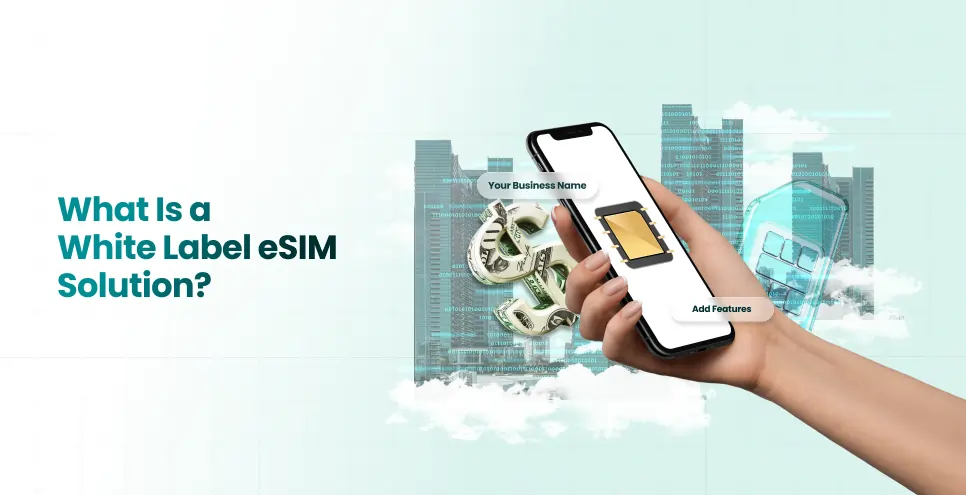
A white label eSIM solution allows travel agencies and digital brands to sell eSIM data plans under their own brand. While a third-party provider handles the telecom infrastructure, carrier connectivity, and eSIM provisioning behind the scenes.
Most people think eSIM is the product. It’s not. The product is the experience—the moment a traveler lands, turns off airplane mode, and expects their phone to work without drama.
What customers actually buy is certainty: the setup doesn’t fail mid-install, the plan activates fast, and support can see what’s happening if something goes wrong. The eSIM is just the delivery method.
That’s where a white label eSIM solution comes in. It lets travel agencies and digital brands sell data plans under their own name—without negotiating with carriers or building provisioning infrastructure. The provider runs the telecom layer. You control the branding, purchase flow, onboarding, and support experience.
Here’s the part most articles blur: “white label eSIM” can mean very different setups. Some launch fast but quietly limit your margins, UX, and scalability. Others scale cleanly—but only if you choose the right platform model from day one.
This guide breaks it down simply: what a white label eSIM solution is, how a white label eSIM platform and eSIM management platform fit together, the three launch models, what usually breaks, and when it makes sense to move beyond templates into a branded eSIM app you actually control.
Quick Summary
- A white label eSIM solution lets you sell eSIM data plans under your brand without building telecom infrastructure.
- It usually includes provisioning, plan management, and a dashboard or eSIM API integration.
- Travel agencies benefit most because connectivity is a “first-hour” travel need and a high-trust upsell.
- There are three launch models: white-label webstore, eSIM reseller API, and custom branded eSIM app.
- The biggest risks are install failures, unclear plan rules, refund friction, and weak support visibility.
- Teams that care about retention and margins typically graduate to custom eSIM app development.
The number of **Travel eSIM users are projected to grow from ~40 million in 2024 to over 215 million by 2028—a 440% increase—as consumers seek cheaper global data options over traditional roaming.
What Is a White Label eSIM Solution?
A white label eSIM solution is a ready-made system that allows a business to sell eSIM mobile data plans using its own branding, while a third-party provider handles the telecom infrastructure in the background.
From the customer’s point of view, everything feels native:
- Your brand name
- Your app or website
- Your payment flow
- Your support emails
Behind the scenes, the eSIM provider supplies:
- Connectivity agreements with mobile carriers
- eSIM profile provisioning
- Usage tracking and lifecycle management
This is why white label eSIM solutions are popular with travel agencies, tour operators, airlines, OTAs, fintech apps, and digital service platforms. They want to add global connectivity fast without hiring telecom engineers or negotiating with carriers country by country.
White Label eSIM Solution vs White Label eSIM Platform
These terms are often used interchangeably, but there’s a subtle difference worth understanding.
- A white label eSIM solution refers to the entire business setup — branding, plans, provisioning, and resale
- A white label eSIM platform usually refers to the software layer — dashboards, APIs, plan catalogs, and control tools
In reality, most providers bundle both. What matters is how much control you actually get over pricing, UX, customer journeys, and support workflows—not what the provider calls the product.
Is a White Label eSIM Solution the Same as an eSIM Management Platform?
Not exactly!
An eSIM management platform is the backend system that:
- Creates and delivers eSIM profiles
- Tracks activation and usage
- Handles suspensions, expiries, and top-ups
- Connects to carrier infrastructure
White label solutions sit on top of an eSIM management platform.
Your customers never see the management platform. Your brand experience depends on how well it’s integrated into your eSIM app or website.
This distinction becomes important later when deciding whether a template-based reseller setup is enough or whether you need deeper integration through APIs or a fully custom eSIM app.
Why Businesses Choose White Label eSIM Solutions
More than half of all certified smartphones now support eSIM, jumping from 15% in 2022 to 51.7% in 2024. The number of eSIM-compatible device models has grown rapidly, showing that manufacturers are prioritizing this technology.
The appeal is simple:
- Fast time to market
- Low upfront cost compared to building telecom infrastructure
- Immediate access to multi-country coverage
- Ability to bundle connectivity with existing products (especially travel)
But speed comes with tradeoffs, and those tradeoffs are exactly where many brands get stuck as they grow. We’ll break those down shortly.
How a White Label eSIM Solution Works (Step by Step)
Many competitor articles simply say “the platform provisions an eSIM.” That skips the parts that actually affect customer experience. Here’s the real flow.
Step 1: The customer buys a plan from your brand
The customer interacts only with you:
- Your website or mobile app
- Your pricing and plan names
- Your checkout flow and payment gateway
- Your confirmation email or in-app message
From their perspective, they’re buying connectivity directly from your brand, not from a telecom company and not from an unknown third party.
Step 2: Your system requests an eSIM profile from the provider
Once payment is confirmed, your system (or the provider’s white-label interface) sends a request to the eSIM management platform in the background.
That request typically includes:
- Plan type (country, region, or global)
- Validity period (7 days, 15 days, 30 days, etc.)
- Data allowance and speed rules
- Customer reference or order ID
At this point, no SIM card is “shipped.” Instead, a digital eSIM profile is prepared.
Step 3: The eSIM profile is generated and secured
Behind the scenes, the provider’s infrastructure does the heavy work:
- Assigns a unique eSIM profile
- Links it to the selected mobile networks
- Sets lifecycle rules (activation, expiry, suspension)
This is handled through standardized remote provisioning systems used across the industry. You don’t need to manage these systems yourself, but their reliability directly affects your customer experience.
If this step fails, customers don’t blame the provider. They blame you.
Step 4: The customer installs the eSIM on their device
The customer receives the eSIM in one of three common ways:
- QR code (email or app)
- Manual activation code
- In-app installation (best UX, fewer errors)
Installation usually takes under two minutes when done right. This step is where many white label eSIM solutions quietly lose customers:
- Confusing instructions
- No device compatibility check
- No guidance for iOS vs Android differences
Strong brands treat installation as part of the product, not an afterthought.
Step 5: Activation and usage begin
Once installed:
- The eSIM connects to a local partner network
- Data usage starts based on the plan rules
- Usage data flows back to the eSIM management platform
Your system can now:
- Show usage status
- Enable top-ups
- Handle expiry notifications
- Assist support if something goes wrong
The customer just sees “it works.” That’s the goal.
What’s Actually Under the Hood
You don’t need to understand telecom acronyms to sell eSIMs—but you do need to know where problems come from.
At a high level:
- eSIMs are delivered using remote SIM provisioning systems
- These systems securely store and transmit eSIM profiles
- Once installed, an eSIM behaves like a physical SIM, just digitally
The standards are largely the same across providers. The real difference is how well reliability, monitoring, and recovery are implemented. That’s why two platforms with “200+ countries” can feel completely different in real-world use.
Read our latest article to learn more about eSIM App Development
Where White Label eSIM Solutions Commonly Break
Experienced brands care about these issues because they happen daily at scale:
- Delayed eSIM delivery during peak travel seasons
- Failed installations with no diagnostics
- Customers switching phones mid-trip
- Refund disputes after partial activation
- Support teams lacking visibility into eSIM status
This is often when brands realize that integration quality matters more than country count.
White Label eSIM Solution vs Custom Branded eSIM App
| Aspect | White Label eSIM Solution | Custom eSIM App Development |
| Time to launch | Fast (days–weeks) | Slower (weeks–months) |
| Brand control | Limited to provider options | Full control over UX/UI |
| Customer journey | Often “generic” | Designed for conversion + trust |
| Support visibility | Depends on provider dashboard | Built around your support workflow |
| Feature flexibility | Limited | Flexible (top-ups, bundles, automation) |
| Unit economics | Often margin-capped | Improves as volume grows |
| Dependency | High (provider UI/tools) | Still uses connectivity partners, but you own the product layer |
| Best for | Testing demand quickly | Scaling, retention, long-term differentiation |
White Label eSIM for Travel Agencies
For travel agencies, the best-performing setup is the one that feels like part of the trip—not an extra purchase.
Where eSIM sells naturally:
- Booking confirmation pages
- Itinerary or pre-departure emails
- Add-ons during checkout
What reduces refunds immediately:
- Device compatibility checks before purchase
- Clear plan labels (“7 days / 5GB / speed policy”)
- Guided install steps for iOS vs Android
- Support views that show activation and usage status
This is why many agencies start with a white label storefront—then move to API or app-based flows once customer volume exposes support bottlenecks.
.
Who Else Benefits (Secondary Audiences)
- Airlines, OTAs, and hotels use eSIMs for upsells and post-booking engagement.
- Digital brands and fintech apps use them as retention or premium features.
- Enterprise and IoT platforms use eSIM management platforms operationally, but their needs are not customer-facing.
This guide intentionally focuses on customer-facing white label eSIM solutions, where branding and UX determine success.
What to Look for in a White Label eSIM Solution (Buyer’s Checklist)
Smart buyers don’t just compare features, they look for failure points. Here’s the checklist that actually matters when choosing a white label eSIM platform or provider:
Connectivity & Coverage
- Carrier quality (not just country count)
- Local vs roaming routes
- Speed throttling transparency
- Fair usage policies clearly defined
Plan & Pricing Control
- Flexible durations and data sizes
- Regional vs country plans
- Top-up support
- Refund and partial-usage handling
Provisioning Reliability
- eSIM delivery success rate
- Retry and recovery mechanisms
- Peak-season performance
Installation & UX
- Device compatibility checks
- iOS vs Android-aware instructions
- In-app installation vs QR-only delivery
- Clear fallback steps when installation fails
Support & Operations
- Real-time eSIM status visibility
- Activation and usage diagnostics
- Ability to assist without escalating to provider
- Support-friendly admin dashboards
Platform & Integration
- API maturity and documentation
- Webhooks for lifecycle events
- Rate limits and scalability
- Security and access controls
This is where many “cheap” white label eSIM solutions quietly become expensive through refunds, bad reviews, and support overload.
What to Ask Before You Choose a White Label eSIM Platform
- Can support see eSIM delivery and installation status in real time?
- What percentage of orders fail provisioning, and how are retries handled?
- How do top-ups work, same profile or new one?
- What does “unlimited” actually mean?
- How are refunds handled after partial activation?
- Do you provide webhooks for activation, expiry, and failures?
- What’s the escalation path during peak travel season?
Cost of a White Label eSIM Setup (Time, Platforms, Scope)
Most white label eSIM pricing looks simple at first glance. In reality, the cost is defined by time, platforms, and scope, not just data pricing.
How Long Does It Take to Launch?
For a proper, brand-ready white label eSIM setup, the realistic delivery window is:
~6 weeks
This includes:
- Platform architecture and provider integration
- eSIM API or dashboard setup
- Purchase, installation, and status flows
- Device testing (iOS & Android differences)
- Failure handling and support visibility
- Launch readiness and monitoring
Anything promised “in a few days” usually relies on rigid templates and comes with limited control.
Platform Scope (What You’re Actually Paying For)
White label eSIM setups are not one-size-fits-all. Cost and complexity change by platform.
| Platform | What It’s Used For | Complexity |
| Web | Checkout, admin, quick launch | Low |
| Android App | Flexible installs, broad device support | Medium |
| iOS App | Premium users, strict OS rules | High |
Most serious travel brands end up needing:
- Web (for management and discovery)
- At least one mobile platform
- Often both iOS and Android for full coverage
Each additional platform adds development, testing, and ongoing maintenance.
What Costs Appear After Launch
These are not “hidden fees” they’re operational realities:
- Support cost per activation
- Refund handling for partial installs
- Failed activations due to device issues
- Time spent explaining plan limits (“unlimited” ≠ unlimited speed)
- Scaling limits of provider dashboards
- Dependency on provider tooling for support decisions
For travel agencies, support cost quickly becomes higher than connectivity cost once volume increases.
Implementation Blueprint (How to Launch Without Breaking Things)
- Choose your launch model (dashboard, API, or app)
- Select a reliable eSIM management platform
- Define clear plans and usage rules
- Design guided onboarding with device checks
- Integrate payments, receipts, and refund logic
- Build real support visibility
- Track activation success and failures
- Iterate based on real customer behavior
Brands that follow this sequence avoid most of the pain competitors never warn about.
Common Mistakes That Hurt White Label eSIM Brands
- Selling “global” plans without speed clarity
- Ignoring device compatibility until after purchase
- Treating installation as a PDF, not a flow
- Giving support no visibility
- No plan for top-ups or extensions
- Relying entirely on provider dashboards
Avoiding these mistakes often matters more than choosing the “best eSIM solution provider”.
Frequently Asked Questions (FAQ)
What is a white label eSIM solution?
A system that lets businesses sell eSIM data plans under their brand while a provider handles the telecom infrastructure.
Is a white label eSIM platform the same as an eSIM management platform?
No. The management platform handles provisioning and lifecycle; white label solutions sit on top of it.
Can travel agencies sell eSIMs under their own brand?
Yes—and they are the most common adopters.
How do customers install eSIMs?
Via QR code, manual activation, or in-app installation. In-app flows reduce errors.
How long does it take to launch?
Days with dashboards, weeks with APIs, and longer for full custom apps.
A Thought to Leave With
A white label eSIM solution isn’t just another product to resell. For travel brands, it’s a way to control one of the most fragile moments in the journey, the first hour after landing.
Templates can get you live quickly. Platforms can help you expand coverage. But the brands that win long-term are the ones that treat connectivity like a product experience: fewer failed installs, fewer refunds, cleaner support, and a journey that feels intentional.If you want your eSIM offering to feel like it belongs to your brand—not your vendor, Kolpolok Limited can build the branded eSIM app and platform layer that makes it reliable, scalable, and easy to operate.