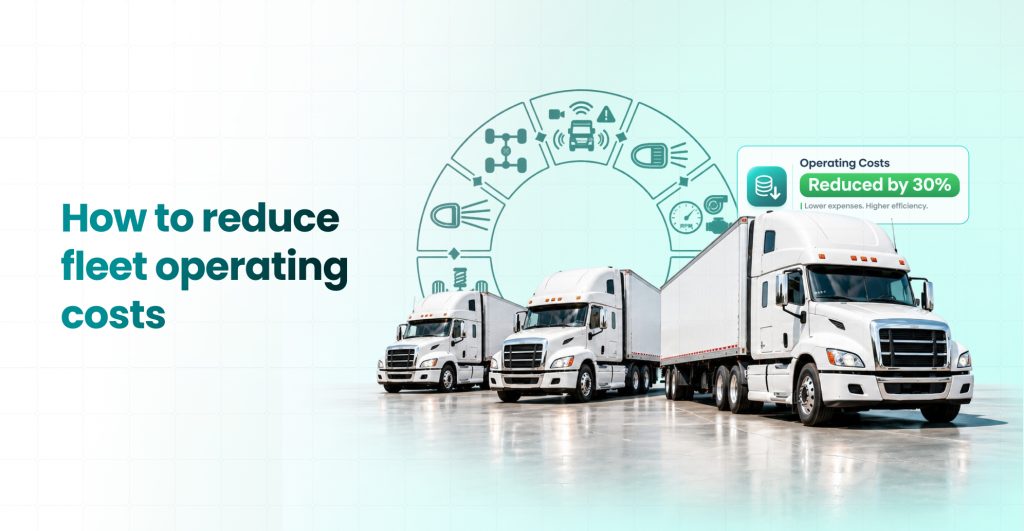
What’s stopping you from controlling your fleet costs? If you don’t know, your system lacks recent fleet data. You can identify many of these problems by reviewing vehicle-level expenses and operational data.
Like you, fleet managers often face rising operating costs without knowing exactly where the extra money goes. The most concerning factors are:
- Fuel consumption increases
- Vehicles travel unnecessary miles
- Maintenance expenses accumulate
Meanwhile, underutilized vehicles continue generating ownership and insurance costs. These expenses can quietly reduce business profitability.
In this article, we explain how to reduce fleet operating costs through better route planning and preventive maintenance, supported by driver profiling. Welcome aboard.
How can I optimize my fleet operations for cost savings?
Businesses can optimize fleet operations for cost savings by tracking each vehicle’s expenses, reducing unnecessary mileage and idling, improving route planning, and following preventive maintenance schedules. They should also monitor driver behavior, identify underused vehicles, and compare total ownership costs before making purchasing decisions.
The first step is establishing an accurate cost baseline.
For example, a fleet manager might discover that a particular vehicle consumes more fuel than similar vehicles. Another vehicle may have unusually high maintenance expenses despite traveling fewer miles.
These findings help managers prioritize improvements based on measurable problems.
Once you understand why fleet management matters, you can help businesses connect operational improvements to broader financial goals.
What are the biggest expenses in fleet operations?
Fleet operating expenses include the costs of purchasing or leasing vehicles, maintaining them, and running daily operations. These expenses vary by fleet type.
- A trucking company may face significant fuel and driver labor costs.
- A corporate vehicle fleet may spend more on financing, insurance, and administration relative to its mileage.
Fixed vs variable fleet costs
First, businesses should separate fixed expenses from variable expenses.
| Cost type | Examples | How businesses can manage it |
| Fixed or ownership costs | Depreciation, lease payments, financing, insurance | Review fleet size, contracts, and replacement decisions |
| Variable operating costs | Fuel, tires, mileage-related maintenance, repairs | Improve routes, driving practices, and servicing |
| Labor and administrative costs | Driver wages, scheduling, reporting | Improve workforce planning and administrative workflows |
Some expenses have both fixed and variable components. For example, driver labor may include regular salaries and overtime payments.
Why should you analyze costs by vehicle?
Fleet-wide totals can hide expensive vehicles.
- Consider two delivery vans traveling approximately 20,000 miles annually.
- One requires $2,000 in repairs while the other requires $5,000.
The second vehicle has an additional $0.15 in repair expenses per mile. This difference may indicate recurring mechanical problems or demanding operating conditions. By comparing similar vehicles, managers can identify which assets deserve further investigation.
How do you calculate fleet operating cost per mile?
Fleet operating cost per mile shows how much a business spends for every mile its vehicles travel. This metric helps managers evaluate operating efficiency and identify changes over time.
Calculate total fleet costs
First, collect the relevant expenses for a defined period. These may include fuel, maintenance, tires, driver expenses, insurance, and applicable ownership costs.
For financial accuracy, use a consistent accounting method. Avoid counting the same ownership expense twice through depreciation and overlapping lease or financing charges.
Use the fleet cost per mile formula
Cost per mile = Total relevant fleet costs ÷ Total miles driven
For example, consider a hypothetical business fleet with the following annual expenses.
| Expense category | Annual cost |
| Fuel | $35,000 |
| Maintenance and repairs | $15,000 |
| Driver labor | $40,000 |
| Insurance | $10,000 |
| Ownership costs | $15,000 |
| Other operating expenses | $5,000 |
| Total | $120,000 |
Suppose the fleet travels 60,000 miles annually.
Cost per mile = $120,000 ÷ 60,000 = $2.00
Under this cost definition, the company spends an average of $2 per mile driven.
Compare cost per mile accurately
Next, calculate the same metric for individual vehicles or comparable vehicle groups. A delivery van and a heavy-duty truck should not automatically be measured against identical cost targets. Their payloads, routes, operating conditions, and responsibilities differ. For better decisions, compare vehicles performing similar work and review cost trends over time.
10 practical ways to reduce fleet operating costs
Businesses can control operating expenses by improving trip planning, vehicle maintenance, driver management, and resource allocation.
The following strategies focus on actions you can measure through operational data.
1. Reduce unnecessary mileage through better route planning
Fleet managers can spend more on fuel and labor when vehicles follow inefficient routes or make repeated trips.
For example, a delivery company may send two vehicles to nearby destinations when one properly scheduled trip could complete both assignments.
Better route planning reduces unnecessary travel and improves coordination. For better planning, you can review trip histories and identify repeated detours or overlapping journeys.
Then evaluate delivery schedules and opportunities to combine suitable trips. Plus, GPS tracking can help businesses review vehicle movement and planned versus actual routes.
2. Minimize excessive vehicle idling
Drivers sometimes leave engines running while waiting for assignments or completing administrative tasks. Unnecessary idling consumes fuel without increasing mileage. It can also contribute to engine wear.
Even the US Department of Energy identifies reduced fuel use and maintenance costs as key benefits of reducing idling. There are solutions to reduce unnecessary idling.
- First, review idle-time records and identify locations where excessive idling regularly occurs.
- Next, introduce practical policies and provide feedback to drivers.
Note: Some vehicles must idle to support specialized equipment, climate control, or operational safety requirements. Policies should account for these situations.
3. Improve fuel consumption monitoring
Fuel is an important expense for many business fleets. Without accurate fuel records, managers may struggle to identify vehicles that consume more fuel than expected.
A practical fuel monitoring process combines:
- Purchase records
- Vehicle mileage
- Supported telematics information
For example, managers can calculate miles per gallon for comparable vehicles and review unusual changes. If a vehicle’s fuel efficiency declines, the team can investigate maintenance conditions, route changes, or driving practices.
Overall, fuel-card transactions may provide additional information where supported. Detecting misuse requires appropriate transaction records and verification controls.
4. Follow a preventive maintenance schedule
Preventive maintenance helps businesses address service needs before they become more expensive problems. For example, a company can schedule tire inspections, brake servicing, and oil changes according to vehicle requirements.
Maintenance schedules may follow calendar intervals, accumulated mileage, or actual vehicle condition. Condition-based maintenance requires suitable diagnostic information and compatible devices.
In addition, centralized maintenance records also help managers identify repeated repairs and overdue services. It is one of the best fleet management practices.
5. Improve driver behavior through practical training
Drivers influence fuel consumption and vehicle condition through everyday decisions. The top reasons for increasing fuel use are:
- Frequent harsh acceleration
- Unnecessary braking
- Excessive speeding
Instead of relying only on warnings, businesses can use objective driving information to guide training. For instance, managers may identify recurring idling or aggressive acceleration and provide targeted coaching.
Besides, the training should consider route conditions and job requirements. A driver operating in heavy urban traffic may have different performance patterns from someone traveling on highways.
6. Identify underutilized vehicles
An underused vehicle may generate insurance, depreciation, or lease expenses even when it completes very few assignments. So, fleet managers should review trip frequency, active operating days, mileage, and vehicle availability.
For example, a corporate office may have three vehicles assigned to separate departments even though their usage schedules rarely overlap. A shared booking system could help the organization evaluate a smaller pool of vehicles.
The official guideline in the US is to evaluate vehicle use and operational needs before deciding which assets to retain. Data source: AFDC
7. Control tire and repair expenses
Tires and recurring repairs can increase operating costs when maintenance problems remain unresolved. Fuel efficiency is affected by:
- Incorrect tire pressure
- Poor alignment
- Excessive tire wear
As a result, fleet managers should use manufacturer-recommended maintenance procedures and keep complete service records. For example, repeated tire replacements on one vehicle may indicate an alignment or loading issue. Reviewing the repair history can help identify the underlying problem instead of treating each incident separately.
8. Centralize fleet procurement and expense records
Fleet expenses become harder to control when individual departments purchase parts and services independently without shared records. Whereas, a centralized system helps managers understand what the business purchases and which vehicles generate expenses.
For instance, the company can track spare parts, repair vendors, fuel purchases, and recurring maintenance contracts. This information supports price comparisons and reduces the risk of duplicate purchases. In this process, businesses may also explore volume purchasing agreements when appropriate.
9. Make vehicle replacement decisions using total cost of ownership
A low-mileage vehicle can still be expensive to maintain. Another may remain economical despite several years of service. Before making decisions, total cost of ownership (TCO) considers purchase or lease expenses, fuel, maintenance, insurance, depreciation, and expected resale value.
10. Reduce administrative workload with fleet management software
When information is scattered across spreadsheets and messages, employees may repeat the same work. Instead, a centralized vehicle management system can organize vehicle records, driver assignments, maintenance schedules, and operational reports.
For example, a company could use digital vehicle requisitions instead of manually collecting requests from multiple departments. The system can also help managers retrieve trip information without searching through separate records.
Which fleet performance indicators should you monitor to reduce costs?
Fleet managers need measurable indicators to understand the impact of operational changes.
A dashboard should help them identify problems and take action, not just display large amounts of data.
| Fleet KPI | What it measures | How it supports cost control |
| Total cost per mile | Relevant costs divided by miles driven | Tracks overall cost efficiency |
| Fuel cost per mile | Fuel expenses divided by miles driven | Highlights fuel spending trends |
| Maintenance cost per vehicle | Maintenance expenses for each asset | Identifies costly vehicles |
| Idle hours | Time spent idling | Highlights unnecessary fuel consumption |
| Vehicle utilization | Actual use relative to defined available capacity | Identifies underused assets |
| Unscheduled downtime | Time vehicles are unexpectedly unavailable | Reveals reliability problems |
| Maintenance compliance | Completed scheduled services divided by services due | Monitors preventive maintenance |
| Cost per trip | Relevant expenses divided by completed trips | Helps evaluate assignment costs |
For example, rising fuel cost per mile may result from higher fuel prices rather than inefficient driving. Therefore, fleet managers should review fuel consumption alongside fuel spending. Similarly, a vehicle with high maintenance costs may still be economical if it performs demanding work that other vehicles cannot handle.
How do you measure actual fleet cost savings?
Businesses should compare operating results before and after implementing improvements. Without a baseline, it becomes difficult to separate real savings from changes in fuel prices or business activity.
Step 1: Establish a cost baseline
First, collect expense and performance records from a representative period. Include fuel consumption, mileage, maintenance expenses, utilization, and relevant operating costs. Use consistent accounting categories so future comparisons remain meaningful.
Step 2: Compare equivalent operating periods
Next, account for changes in workload and external conditions. For example, a fleet may spend less on fuel because it completed fewer deliveries. That does not necessarily indicate improved efficiency. Comparing fuel consumption per mile and cost per completed assignment can provide additional context.
Step 3. Calculate net savings
Use the following formula:
Net savings = Avoided operating costs − Implementation and ongoing costs
Consider a hypothetical fleet improvement project.
| Item | Amount |
| Estimated operating costs avoided | $18,000 |
| Software and implementation costs | $5,000 |
| Training and additional operating costs | $2,000 |
| Net savings | $11,000 |
Notes:
In this example, the business achieves $11,000 in calculated net savings for the evaluation period. These are illustrative figures, not documented customer results. Base actual savings on comparable operating conditions and verified expense records.
A practical 90-day fleet cost reduction plan
Businesses can organize their improvement efforts into a 90-day implementation plan.
The purpose is to establish a baseline, make targeted operational changes, and measure the results.
Days 1–30: Analyze your fleet expenses
During the first month, focus on understanding current performance. Collect fuel, maintenance, mileage, and operating expense records for each vehicle.
Next, calculate cost per mile and identify assets with unusually high expenses. Review idle-time data and trip histories where available.
Also check vehicle utilization to identify assets that may be assigned inefficiently. At month-end, create a baseline report with measurable indicators.
Expected deliverable: A vehicle-level cost report and a prioritized list of improvement opportunities.
Days 31–60: Implement cost-saving actions
During the second month, begin addressing the most important issues. For example, managers can review inefficient routes, introduce practical idle reduction policies, and complete overdue maintenance.
Driver training can focus on identified behaviors rather than generic advice. Additionally, evaluate underused vehicles and consider reassignment where operationally appropriate.
Expected deliverable: Implemented operational improvements with defined owners and measurable targets.
Days 61–90: Monitor and improve results
During the third month, compare new operating data with the initial baseline. Review changes in fuel consumption, maintenance expenses, utilization, and downtime.
If a strategy produces encouraging results, consider expanding it to other suitable vehicles.
Meanwhile, investigate initiatives that show limited improvement. This is also a good time to review additional tracking tools or fleet reporting capabilities.
Finally, establish monthly performance reviews so the process continues beyond the initial project.
Expected deliverable: A cost comparison report and a repeatable fleet performance review process.
(A 90-day plan provides a practical starting point. The actual financial impact will depend on fleet conditions and implementation quality.)
How does fleet management software help businesses control operating costs?
Fleet management software helps businesses collect and organize information about vehicles and daily operations.
- GPS tracking can provide trip visibility.
- Maintenance records help teams schedule servicing.
- Driver activity and fuel information can support performance reviews.
For example, a fleet manager might combine trip records with fuel expenses to identify vehicles requiring investigation. A centralized dashboard can make those comparisons easier than working across disconnected spreadsheets.
Please keep in mind that businesses must interpret the information and make operational decisions based on the findings. For this reason, fleet managers should evaluate software based on their requirements and existing systems.
Read more: 7 benefits of proper fleet management software
How Goti VMS by Kolpolok Limited supports fleet cost management
Goti VMS is a vehicle management software product developed by Kolpolok Limited.
The platform helps businesses manage vehicles, monitor operational activity, and organize administrative workflows through a centralized system. Its capabilities can support several fleet cost management activities.
Final thoughts
Businesses can reduce fleet operating costs by understanding their expenses and making consistent operational improvements. The most effective cost-reduction factors are better route planning, less unnecessary idling, preventive maintenance, and improved vehicle utilization, which can help control spending. Contact us for more information.
Frequently asked questions
How can I optimize my fleet operations for cost savings?
To optimize your fleet costs, reduce unnecessary mileage and idling, improve maintenance planning, and review driver performance. Plus, monitor vehicle utilization and compare performance indicators regularly to identify improvements supported by actual operating data.
What is the biggest expense in fleet management?
The largest expense depends on fleet type and operating conditions. Fuel, driver labor, maintenance, vehicle ownership, and insurance can all represent high costs. Businesses should analyze their own records rather than assume one expense category is always the largest.
How do I calculate fleet operating cost per mile?
Divide total relevant fleet costs by the total miles driven during the same period. For example, $120,000 in annual costs across 60,000 miles equals $2 per mile. Use consistent cost categories when comparing periods.
How can fleet management software reduce fuel costs?
Fleet software can help managers review trip distances, idle time, and available fuel consumption records. These insights support route planning and driver coaching. Actual savings depend on the improvements implemented and the quality of the underlying data.
How can I identify underutilized fleet vehicles?
Review trip frequency, active operating days, mileage, and vehicle assignments. Compare actual usage with operational needs. Vehicles with consistently low utilization may be candidates for reassignment, shared use, or removal after a business assessment.
Can Goti VMS help businesses control fleet expenses?
Goti VMS provides vehicle tracking, maintenance management, driver administration, fuel monitoring, and operational reporting. These features can help businesses identify cost-related issues and organize improvement efforts. The results depend on configuration and actual usage.